Criminal IP Operation
The web format of this guide reflects the most current release. Guides for older iterations are available in PDF format.
Integration Details
ThreatQuotient provides the following details for this integration:
| Current Integration Version | 1.1.0 |
| Compatible with ThreatQ Versions | >= 5.6.0 |
| Support Tier | ThreatQ Supported |
Introduction
The Criminal IP Operation for ThreatQ enhances analyst workflows by integrating rich contextual intelligence on internet-connected systems directly into the platform. Criminal IP provides detailed insights such as open ports, vulnerabilities, WHOIS data, and other network attributes that help identify malicious activity and strengthen the evaluation of indicators of compromise (IOCs).
The integration provides the following operation action:
- Criminal IP Query IP - queries Criminal IP for contextual information on IP addresses.
- Criminal IP Get Domain Reports - performs a domain reports lookup against Criminal IP.
The integration is compatible with IP Address and FQDN indicator types.
Prerequisites
The following is required to run the integration:
- A Criminal IP API Key.
Installation
Perform the following steps to install the integration:
The same steps can be used to upgrade the integration to a new version.
- Log into https://marketplace.threatq.com/.
- Locate and download the integration whl file.
- Navigate to the integrations management page on your ThreatQ instance.
- Click on the Add New Integration button.
- Upload the integration file using one of the following methods:
- Drag and drop the file into the dialog box
- Select Click to Browse to locate the integration file on your local machine
ThreatQ will inform you if the operation already exists on the platform and will require user confirmation before proceeding. ThreatQ will also inform you if the new version of the operation contains changes to the user configuration. The new user configurations will overwrite the existing ones for the operation and will require user confirmation before proceeding.
The operation is now installed and will be displayed in the ThreatQ UI. You will still need to configure and then enable the operation.
Configuration
ThreatQuotient does not issue API keys for third-party vendors. Contact the specific vendor to obtain API keys and other integration-related credentials.
To configure the integration:
- Navigate to your integrations management page in ThreatQ.
- Select the Operation option from the Type dropdown (optional).
- Click on the integration entry to open its details page.
- Enter the following parameters under the Configuration tab:
Parameter Description API Key Enter your Criminal IP API Key. Enable SSL Certificate Verification Enable this parameter if the operation should validate the host-provided SSL certificate. Bypass System Proxy
Configuration for this
OperationEnable this parameter if the operation should not honor proxies set in the ThreatQ UI.
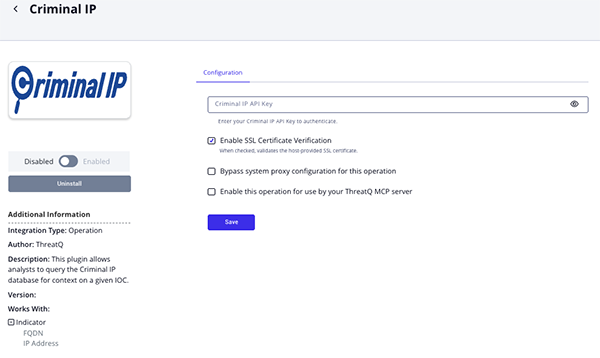
- Review any additional settings, make any changes if needed, and click on Save.
- Click on the toggle switch, located above the Additional Information section, to enable it.
Actions
The operation provides the following actions:
| Action | Description | Object Type | Object Subtype |
|---|---|---|---|
| Query IP | Performs an IP lookup against Criminal IP. | Indicators | IP Address |
| Get Domain Reports | Performs a domain reports lookup against Criminal IP. | Indicators | FQDN |
Query IP
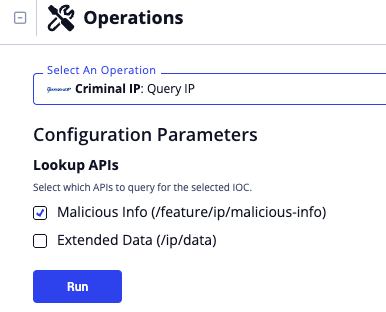
The Criminal IP - Query IP action performs a URL lookup against the Criminal IP API to see if a given URL is a known phishing indicator. The type of requests and selected APIs are set in operation's Lookup APIs run parameter that is accessible from an object's details page.
Run Configuration Option
The following configuration option is set after selecting the action to run against an object and are not set from the operation's configuration screen.
The following configuration option is available for this operation action:
| Parameter | Description |
|---|---|
| Lookup APIs | Select which APIs to query for the selected IOC. Options include:
|
Malicious Info
The following are the sample response and mapping tables if you have selected the Malicious Info option for the Lookup APIs run configuration option.
GET https://api.criminalip.io/v2/feature/ip/malicious-info?ip={ip}
Sample Response:
{
  "status": 200,
  "ip": "45.148.10.81",
  "is_malicious": true,
  "is_vpn": false,
  "can_remote_access": true,
  "current_opened_port": {
    "count": 2,
    "data": [
      {
        "socket_type": "tcp",
        "port": 22,
        "protocol": "ssh",
        "product_name": "openssh",
        "product_version": "7.6p1",
        "has_vulnerability": false,
        "confirmed_time": "2023-03-19 13:14:46"
      },
      {
        "socket_type": "tcp",
        "port": 80,
        "protocol": "http",
        "product_name": "apache",
        "product_version": "2.4.29",
        "has_vulnerability": true,
        "confirmed_time": "2023-03-20 08:16:04"
      }
    ]
  },
  "remote_port": {
    "count": 1,
    "data": [
      {
        "socket_type": "tcp",
        "port": 22,
        "protocol": "ssh",
        "product_name": "openssh",
        "product_version": "7.6p1",
        "has_vulnerability": false,
        "confirmed_time": "2023-03-19 13:14:46"
      }
    ]
  },
  "vulnerability": {
    "count": 51,
    "data": [
      {
        "cve_id": "CVE-2023-25690",
        "cwe_ids": [444],
        "edb_ids": [],
        "ports": {
          "tcp": [80],
          "udp": []
        },
        "cvssv2_vector": "",
        "cvssv2_score": 0,
        "cvssv3_vector": "NETWORK",
        "cvssv3_score": 9.8,
        "product_name": "apache",
        "product_version": "2.4.29",
        "product_vendor": "apache"
      },
      {
        "cve_id": "CVE-2022-37436",
        "cwe_ids": [436, 113],
        "edb_ids": [],
        "ports": {
          "tcp": [80],
          "udp": []
        },
        "cvssv2_vector": "",
        "cvssv2_score": 0,
        "cvssv3_vector": "NETWORK",
        "cvssv3_score": 5.3,
        "product_name": "apache",
        "product_version": "2.4.29",
        "product_vendor": "apache"
      }
    ]
  },
  "ids": {
    "count": 2,
    "data": [
      {
        "classification": "3coresec",
        "url": "blacklist.3coresec.net/lists/et-open.txt",
        "message": "ET 3CORESec Poor Reputation IP UDP group 26",
        "source_system": "./snort-2.9.0 10182",
        "confirmed_time": "2022-11-28 21:26:39"
      },
      {
        "classification": "ciarmy",
        "url": "www.cinsscore.com",
        "message": "ET CINS Active Threat Intelligence Poor Reputation IP UDP group 37",
        "source_system": "./snort-2.9.0 10272",
        "confirmed_time": "2023-03-20 07:39:51"
      }
    ]
  },
  "scanning_record": {
    "count": 20,
    "data": [
      {
        "log_date": "Wed, 17 Aug 2022 00:00:00 GMT",
        "dst_port": 80,
        "protocol_type": "tcp",
        "user_agent": "Go-http-client/1.1\r",
        "message": "[17/Aug/2022:07:01:43] GET http://example.com/ HTTP/1.1",
        "confirmed_time": "2022-08-17 00:00:00"
      },
      {
        "log_date": "Sun, 07 Aug 2022 00:00:00 GMT",
        "dst_port": 8090,
        "protocol_type": "tcp",
        "user_agent": "-\r",
        "message": "[07/Aug/2022:16:21:29] Phsa",
        "confirmed_time": "2022-08-07 00:00:00"
      }
    ]
  },
  "ip_category": {
    "count": 6,
    "data": [
      {
        "type": "attack (Low)",
        "detect_source": "C-TAS(igloosec)",
        "confirmed_time": "2022-09-23 17:05:39"
      },
      {
        "type": "bruteforce (fail2ban)",
        "detect_source": "",
        "confirmed_time": "2022-08-18 15:27:50"
      }
    ]
  }
}
ThreatQuotient provides the following default mapping for this run request:
| Feed Data Path | ThreatQ Entity | ThreatQ Object Type or Attribute Key | Published Date | Examples | Notes |
|---|---|---|---|---|---|
.is_malicious |
Indicator.attribute |
Is Malicious |
N/A |
true |
N/A |
.is_vpn |
Indicator.attribute |
Is VPN |
N/A |
false |
N/A |
.can_remote_access |
Indicator.attribute |
Can Remote Accress |
N/A |
true |
N/A |
.ip_category.data[].type |
Indicator.attribute |
Category |
N/A |
attack (Low) |
N/A |
.ip_category.data[].detect_source |
Indicator.attribute |
Category Detection Source |
N/A |
C-TAS(igloosec) |
N/A |
.current_opened_port.data[].port |
Indicator.attribute |
Open Port |
N/A |
80 |
N/A |
.ids.data[].classification |
Indicator.attribute |
IDS Classification |
N/A |
3coresec |
N/A |
.ids.data[].message |
Indicator.attribute |
IDS Message |
N/A |
ET CINS Active Threat Intelligence Poor Reputation IP UDP group 37 |
N/A |
.ids.data[].url |
Indicator.attribute |
External Reference |
N/A |
N/A |
N/A |
.vulnerability.data[].cve_id |
Indicator.value |
CVE |
N/A |
CVE-2023-11423 |
N/A |
.vulnerability.data[].cwe_ids[] |
Related Indicator.attribute |
CWE ID |
N/A |
CWE-444 |
Prefixed with CWE- from cwe_ids[]. |
.vulnerability.data[].product_name |
Related Indicator.attribute |
Affected Product |
N/A |
Apache |
N/A |
.vulnerability.data[].product_version |
Related Indicator.attribute |
Affected Product Version |
N/A |
9.3p1 |
N/A |
.vulnerability.data[].product_vendor |
Related Indicator.attribute |
Affected Vendor |
N/A |
Apache |
N/A |
.vulnerability.data[].cvssv2_vector |
Related Indicator.attribute |
CVSSv2 Vector |
N/A |
NETWORK |
N/A |
.vulnerability.data[].cvssv3_vector |
Related Indicator.attribute |
CVSSv3 Vector |
N/A |
NETWORK |
N/A |
.vulnerability.data[].cvssv2_score |
Related Indicator.attribute |
CVSSv2 Score |
N/A |
7.9 |
Value should be > 0 |
.vulnerability.data[].cvssv3_score |
Related Indicator.attribute |
CVSSv3 Score |
N/A |
6.5 |
Value should be > 0 |
Extended Data
The following are the sample response and mapping tables if you have selected the Extend Data option for the Lookup APIs run configuration option.
GET https://api.criminalip.io/v1/ip/data?ip={ip}&full=true
Sample Response (truncated):
{
  "ip": "45.148.10.81",
  "tags": {
    "is_vpn": false,
    "is_cloud": false,
    "is_tor": false,
    "is_proxy": false,
    "is_hosting": false,
    "is_mobile": false,
    "is_darkweb": false,
    "is_scanner": false,
    "is_snort": true
  },
  "score": {
    "inbound": 5,
    "outbound": 5
  },
  "user_search_count": 4,
  "whois": {
    "count": 1,
    "data": [{
      "as_name": "Pptechnology Limited",
      "as_no": 48090,
      "city": "Amsterdam",
      "org_name": "DMZHOST",
      "postal_code": "1012",
      "longitude": 4.8883,
      "latitude": 52.3716,
      "org_country_code": "nl",
      "confirmed_time": "2023-03-20 00:00:00"
    }]
  },
  "ids": {
    "count": 2,
    "data": [{
      "classification": "3coresec",
      "url": "blacklist.3coresec.net/lists/et-open.txt",
      "message": "ET 3CORESec Poor Reputation IP UDP group 26",
      "source_system": "./snort-2.9.0 10182",
      "confirmed_time": "2022-11-28 21:26:39"
    }]
  },
  "ip_category": {
    "count": 6,
    "data": [{
      "type": "malware",
      "confirmed_time": "2022-05-17 15:03:17"
    }, {
      "type": "reputation (ban_list)",
      "confirmed_time": "2022-08-30 15:06:01"
    }]
  },
  "port": {
    "count": 26,
    "data": [{
      "app_name": "Apache",
      "app_version": "2.4.29",
      "open_port_no": 80,
      "protocol": "HTTP",
      "socket": "tcp",
      "is_vulnerability": true,
      "banner": "HTTP/1.1 Status: 200 OK ... Server: Apache/2.4.29 (Ubuntu)",
      "confirmed_time": "2023-03-20 08:16:04"
    }, {
      "app_name": "OpenSSH",
      "app_version": "7.6p1",
      "open_port_no": 22,
      "protocol": "SSH",
      "socket": "tcp",
      "banner": "SSH-2.0-OpenSSH_7.6p1 Ubuntu-4ubuntu0.7 ...",
      "confirmed_time": "2023-03-19 13:14:46"
    }]
  },
  "vulnerability": {
    "count": 51,
    "data": [{
      "cve_id": "CVE-2023-25690",
      "cvssv3_score": 9.8,
      "app_name": "Apache",
      "app_version": "2.4.29",
      "vendor": "apache",
      "cwe_name": "HTTP Request/Response Smuggling"
    }, {
      "cve_id": "CVE-2022-37436",
      "cvssv3_score": 5.3,
      "app_name": "Apache",
      "app_version": "2.4.29",
      "vendor": "apache",
      "cwe_name": "HTTP Request/Response Splitting"
    }]
  },
  "status": 200
}
ThreatQuotient provides the following default mapping for this run request:
| Feed Data Path | ThreatQ Entity | ThreatQ Object Type or Attribute Key | Published Date | Examples | Notes |
|---|---|---|---|---|---|
.tags.is_vpn |
Attribute |
Is VPN |
N/A |
true |
N/A |
.tags.is_cloud |
Attribute |
Is Cloud |
N/A |
false |
N/A |
.tags.is_tor |
Attribute |
Is TOR |
N/A |
false |
N/A |
.tags.is_proxy |
Attribute |
Is Proxy |
N/A |
false |
N/A |
.tags.is_hosting |
Attribute |
Is Hosting |
N/A |
false |
N/A |
.tags.is_mobile |
Attribute |
Is Mobile |
N/A |
false |
N/A |
.tags.is_darkweb |
Attribute |
Is Dark Web |
N/A |
false |
N/A |
.tags.is_scanner |
Attribute |
Is Scanner |
N/A |
false |
N/A |
.tags.is_snort |
Attribute |
Is Snort |
N/A |
true |
N/A |
.score.inbound |
Attribute |
Inbound Score |
N/A |
5 |
N/A |
.score.outbound |
Attribute |
Outbound Score |
N/A |
5 |
N/A |
.vpn.data[].vpn_name |
Attribute |
VPN Name |
N/A |
NordVPN |
N/A |
.vpn.data[].vpn_source_url |
Attribute |
VPN Source URL |
N/A |
N/A |
N/A |
.honeypot.data[].detect_reason |
Attribute |
Honeypot Detect Reason |
N/A |
N/A |
N/A |
.honeypot.data[].scan_object |
Attribute |
Honeypot Scan Object |
N/A |
N/A |
N/A |
.honeypot.data[].protocol_type |
Attribute |
Honeypot Protocol Type |
N/A |
N/A |
N/A |
.honeypot.data[].dst_port |
Attribute |
Honeypot Destination Port |
N/A |
N/A |
N/A |
.ip_category.data[].type |
Attribute |
Category |
N/A |
attack (Low) |
N/A |
.ip_category.data[].detect_source |
Attribute |
Category Detection Source |
N/A |
C-TAS(igloosec) |
N/A |
.whois.data[].as_name |
Attribute |
AS Name |
N/A |
Pptechnology Limited |
N/A |
.whois.data[].as_no |
Attribute |
ASN |
N/A |
48090 |
N/A |
.whois.data[].city |
Attribute |
City |
N/A |
Amsterdam |
N/A |
.whois.data[].org_name |
Attribute |
Organization |
N/A |
DMZHOST |
N/A |
.whois.data[].postal_code |
Attribute |
Postal Code |
N/A |
1012 |
N/A |
.whois.data[].longitude |
Attribute |
Longitude |
N/A |
4.8883 |
N/A |
.whois.data[].latitude |
Attribute |
Latitude |
N/A |
52.3716 |
N/A |
.whois.data[].org_country_code |
Attribute |
Country Code |
N/A |
nl |
N/A |
.vulnerability.data[].cve_id |
Indicator |
CVE |
N/A |
N/A |
N/A |
.vulnerability.data[].cve_description |
Attribute |
CVE Description |
N/A |
N/A |
N/A |
.vulnerability.data[].cvssv2_vector |
Attribute |
CVSSv2 Vector |
N/A |
N/A |
N/A |
.vulnerability.data[].cvssv2_score |
Attribute |
CVSSv2 Score |
N/A |
N/A |
N/A |
.vulnerability.data[].cvssv3_vector |
Attribute |
CVSSv3 Vector |
N/A |
N/A |
N/A |
.vulnerability.data[].cvssv3_score |
Attribute |
CVSSv3 Score |
N/A |
N/A |
N/A |
.vulnerability.data[].list_cwe[].cwe_id |
Attribute |
CWE ID |
N/A |
N/A |
Prefixed with CWE- (e.g. CWE-444). |
.vulnerability.data[].list_cwe[].cwe_name |
Attribute |
CWE Name |
N/A |
N/A |
N/A |
.vulnerability.data[].app_name |
Attribute |
Vulnerable Application |
N/A |
Apache |
N/A |
.ids.data[].classification |
Attribute |
IDS Classification |
N/A |
3coresec |
N/A |
.ids.data[].message |
Attribute |
IDS Message |
N/A |
ET CINS Active Threat Intelligence Poor Reputation IP UDP group 37 |
N/A |
.ids.data[].url |
Attribute |
External Reference |
N/A |
N/A |
N/A |
Get Domain Reports
The Get Domain Reports operation action performs a domain reports lookup against the Criminal IP API for FQDN indicators.
GET https://api.criminalip.io/v1/domain/reports?query={domain}offset=0
Sample Response
{
  "status": 200,
  "message": "api success",
  "data": {
    "count": 4082,
    "reports": [
      {
        "connected_ip_cnt": 1,
        "country_code": [""],
        "issue": ["list_of_countries", "mail_server", "diff_domain_favicon"],
        "jarm": "27d40d40d00040d1dc42d43d00041d6183ff1bfae51ebd88d70384363d525c",
        "reg_dtime": "2026-05-18 10:04:38",
        "scan_id": "55765539",
        "score": "Safe",
        "technologies": [
          {
            "logo_url": "https://cip-live-image.s3.us-west-1.amazonaws.com/tech/CloudFlare.svg",
            "tech_name": "Cloudflare"
          }
        ],
        "title": "Example Domain",
        "url": "https://example.com"
      }
    ]
  }
}
ThreatQuotient provides the following default mapping for this run request:
| Feed Data Path | ThreatQ Entity | ThreatQ Object Type or Attribute Key | Published Date | Examples | Notes |
|---|---|---|---|---|---|
.data.count |
Indicator.attribute |
Report Count |
N/A |
4082 |
N/A |
.data.reports[].url |
Indicator.value |
URL or FQDN |
N/A |
https://example.com |
URLs are added as URL indicators. |
.data.reports[].score |
Related Indicator.attribute |
Criminal IP Score |
N/A |
Safe |
N/A |
.data.reports[].title |
Related Indicator.attribute |
Title |
N/A |
Example Domain |
N/A |
.data.reports[].scan_id |
Related Indicator.attribute |
Criminal IP Scan ID |
N/A |
55765539 |
N/A |
.data.reports[].reg_dtime |
Related Indicator.attribute |
Criminal IP Report Time |
N/A |
2026-05-18 10:04:38 |
N/A |
.data.reports[].connected_ip_cnt |
Related Indicator.attribute |
Connected IP Count |
N/A |
1 |
N/A |
.data.reports[].country_code[] |
Related Indicator.attribute |
Country Codes |
N/A |
us |
Empty values are ignored. |
.data.reports[].issue[] |
Related Indicator.attribute |
Criminal IP Issues |
N/A |
mail_server |
N/A |
.data.reports[].technologies[].tech_name |
Related Indicator.attribute |
Technologies |
N/A |
Cloudflare |
N/A |
.data.reports[].jarm |
Related Indicator.attribute |
JARM |
N/A |
27d40d40d00040d1dc42d43d00041d6183ff1bfae51ebd88d70384363d525c |
N/A |
Change Log
- Version 1.1.0
- Updated the IP Malicious Info lookup to use the Criminal IP
/v2/feature/ip/malicious-infoendpoint. - Added the Get Domain Reports action for FQDN indicators using the
/v1/domain/reportsendpoint. - Added a new configuration parameter to enable SSL certificate verification for Criminal IP API requests.
- Updated the IP Malicious Info lookup to use the Criminal IP
- Version 1.0.0
- Initial release
PDF Guides
| Document | ThreatQ Version |
|---|---|
| Criminal IP Operation Guide v1.1.0 | 5.6.0 or Greater |
| Criminal IP Operation Guide v1.0.0 | 5.6.0 or Greater |