Cofense Intelligence CDF
The web format of this guide reflects the most current release. Guides for older iterations are available in PDF format.
Integration Details
ThreatQuotient provides the following details for this integration:
| Current Integration Version | 1.0.8 |
| Compatible with ThreatQ Versions | >= 4.35.0 |
| Support Tier | ThreatQ Supported |
Introduction
Cofense Intelligence delivers high-fidelity phishing indicators and contextual information highlighting attacker tactics across their global criminal operation.
Security teams can easily operationalize Cofense Intelligence indicators in the ThreatQ platform. Indicators of phishing, such as attack vectors and malware families, help analysts in their phishing defense. Automatically deploy prioritized and relevant data to your sensor grid for detection and blocking.
The CDF provides the following feeds:
- Cofense Intelligence - retrieves objects from Cofense Intelligence and enrich them with related data.
- Cofense Intelligence Credential Phishing - retrieves objects from Cofense Intelligence and enrich them with related data with the possibility to filter based on the malware family.
The integration ingests the following system objects:
- Adversaries
- Adversary Attributes
- Attachments
- Events
- Event Attributes
- Indicators
- Indicator Attributes
- Malware
Installation
Perform the following steps to install the integration:
The same steps can be used to upgrade the integration to a new version.
- Log into https://marketplace.threatq.com/.
- Locate and download the integration file.
- Navigate to the integrations management page on your ThreatQ instance.
- Click on the Add New Integration button.
- Upload the integration file using one of the following methods:
- Drag and drop the file into the dialog box
- Select Click to Browse to locate the integration file on your local machine
- Select the individual feeds to install, when prompted, and click Install.
ThreatQ will inform you if the feed already exists on the platform and will require user confirmation before proceeding. ThreatQ will also inform you if the new version of the feed contains changes to the user configuration. The new user configurations will overwrite the existing ones for the feed and will require user confirmation before proceeding.
The feed(s) will be added to the integrations page. You will still need to configure and then enable the feed(s).
Configuration
ThreatQuotient does not issue API keys for third-party vendors. Contact the specific vendor to obtain API keys and other integration-related credentials.
To configure the integration:
- Navigate to your integrations management page in ThreatQ.
- Select the Commercial option from the Category dropdown (optional).
If you are installing the integration for the first time, it will be located under the Disabled tab.
- Click on the integration entry to open its details page.
- Enter the following parameters under the Configuration tab:
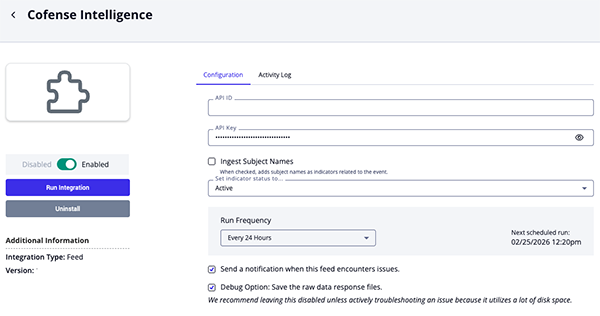
Cofense Intelligence Parameters
Parameter Description API ID Enter your Cofense API ID. API Key Enter your Cofense API Key. Ingest Subject Names Enable this parameter to have the feed ingest subject names as indicators related to the event. Enable SSL Certificate Verification Enable this parameter if the feed should validate the host-provided SSL certificate. Disable Proxies Enable this parameter if the feed should not honor proxies set in the ThreatQ UI.
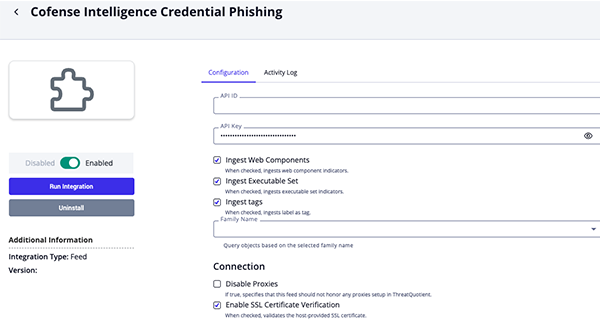
Cofense Intelligence Credential Phishing Parameters
Parameter Description API ID Enter your Cofense API ID. API Key Enter your Cofense API Key. Ingest Web Components Enable this parameter to ingest web component indicators. Ingest Executable Set Enable this parameter to ingest executable set indicators. Ingest Tags Enable this parameter to ingest labels as tags. Family Name Select the family name to use when querying objects. Enable SSL Certificate Verification Enable this parameter if the feed should validate the host-provided SSL certificate. Disable Proxies Enable this parameter if the feed should not honor proxies set in the ThreatQ UI.
- Review any additional settings, make any changes if needed, and click on Save.
- Click on the toggle switch, located above the Additional Information section, to enable it.
ThreatQ Mapping
Cofense Intelligence
The Cofense Intelligence feed retrieves objects from Cofense Intelligence and enrich them with related data.
GET https://www.threathq.com/apiv1/threat/search?threatType=malware
Sample Response:
{
  "success": true,
  "data": {
    "page": {
      "currentPage": 0,
      "currentElements": 1,
      "totalPages": 1,
      "totalElements": 1
    },
    "threats": [
      {
        "id": 38663,
        "relatedSearchTags": [],
        "feeds": [
          {
            "id": 23,
            "permissions": {
              "WRITE": false,
              "OWNER": false,
              "READ": true
            },
            "displayName": "Cofense"
          }
        ],
        "blockSet": [
          {
            "deliveryMechanism": {
              "mechanismName": "GuLoader",
              "description": "Malware Downloader"
            },
            "impact": "Major",
            "confidence": 0,
            "blockType": "URL",
            "roleDescription": "Location from which a payload is obtained",
            "role": "Payload",
            "data": "https://drive.google.com/u/0/uc?id=1NsGADL4jYjlnVLwjmdivMe3I5yTTalVy&export=download",
            "data_1": {
              "url": "https://drive.google.com/u/0/uc?id=1NsGADL4jYjlnVLwjmdivMe3I5yTTalVy&export=download",
              "domain": "google.com",
              "query": "id=1NsGADL4jYjlnVLwjmdivMe3I5yTTalVy&export=download",
              "path": "/u/0/uc",
              "protocol": "https",
              "host": "drive.google.com"
            }
          },
          {
            "malwareFamily": {
              "familyName": "Remcos Remote Access Trojan",
              "description": "Remcos is a remote access trojan or RAT, used to take control of a user’s system. It has multiple capabilities, chief among them is the ability for key logging, information stealing, and audio/visual monitoring."
            },
            "impact": "Moderate",
            "confidence": 0,
            "blockType": "Domain Name",
            "roleDescription": "Command and control location used by malware",
            "role": "C2",
            "data": "dns.pepsi25.xyz",
            "data_1": "dns.pepsi25.xyz"
          }
        ],
        "campaignBrandSet": [
          {
            "totalCount": 1,
            "brand": {
              "id": 599,
              "text": "UPS"
            }
          }
        ],
        "extractedStringSet": [],
        "domainSet": [],
        "senderEmailSet": [],
        "executableSet": [
          {
            "malwareFamily": {
              "familyName": "Remcos Remote Access Trojan",
              "description": "Remcos is a remote access trojan or RAT, used to take control of a user’s system. It has multiple capabilities, chief among them is the ability for key logging, information stealing, and audio/visual monitoring."
            },
            "vendorDetections": [],
            "fileName": "Juei",
            "type": "Download",
            "dateEntered": 1588944174529,
            "severityLevel": "Major",
            "md5Hex": "6dd7c57fd11acea9111b023c27e7eb56"
          },
          {
            "deliveryMechanism": {
              "mechanismName": "GuLoader",
              "description": "Malware Downloader"
            },
            "vendorDetections": [],
            "fileName": "README.EXE",
            "type": "Attachment",
            "ssdeep": "12288:unUo0e4kMU/NOJF19U9aZqr18iN1uwIoVBXiDjN5dLro6gVZ4glUSamtZsCNisW0:4U96dNOz15Zqr1t3IoTy1CLlGmjs+",
            "dateEntered": 1588941795872,
            "severityLevel": "Major",
            "md5Hex": "b6c8d83223ea073c01d40fafe866466b",
            "sha1Hex": "3341cb5f684cb690e3a92dc8884fcb0c28bf47a3",
            "sha224Hex": "4087a2cee7405842aeb47a0a364e2791d6ca52612bc4865cc42a3dbb",
            "sha256Hex": "ae3295c31bb70b2970c9acb33c40bae503de989ed9d696842a44c866e7bafa55",
            "sha384Hex": "b099de38567532dc9675a31d2d6cd1e57bd613d0649c3ec0f9a5ce4ca7efd935113e26c6182ca1b5892a342e1cfcc490",
            "sha512Hex": "b23ada84e5a6cf6260b05423e637481dbfa9fde7c1462d2b9682715bb8e1865e3e0fffd4978b7a4df17c82384655eebfdfc6b9a6a00380b0dbf366fc66ded354",
            "fileNameExtension": "EXE"
          }
        ],
        "senderIpSet": [],
        "senderNameSet": [],
        "spamUrlSet": [],
        "subjectSet": [
          {
            "totalCount": 1,
            "subject": "UPS - Pending delivery"
          }
        ],
        "campaignLanguageSet": [
          {
            "languageDefinition": {
              "isoCode": "en",
              "name": "English",
              "nativeName": "English",
              "family": "Indo-European"
            }
          }
        ],
        "lastPublished": 1588946280590,
        "firstPublished": 1588946277933,
        "label": "Shipping - GuLoader, Remcos RAT",
        "executiveSummary": "UPS-spoofed emails deliver Remcos RAT via GuLoader.",
        "hasReport": true,
        "reportURL": "https://www.threathq.com/api/l/activethreatreport/38663/html",
        "apiReportURL": "https://www.threathq.com/apiv1/t3/malware/38663/html",
        "threatDetailURL": "https://www.threathq.com/p42/search/default?m=38663",
        "threatType": "MALWARE",
        "malwareFamilySet": [
          {
            "familyName": "Remcos Remote Access Trojan",
            "description": "Remcos is a remote access trojan or RAT, used to take control of a user’s system. It has multiple capabilities, chief among them is the ability for key logging, information stealing, and audio/visual monitoring."
          }
        ],
        "deliveryMechanisms": [
          {
            "mechanismName": "GuLoader",
            "description": "Malware Downloader"
          }
        ],
        "naicsCodes": []
      },
	  ...
    ]
  }
}
ThreatQuotient provides the following default mapping for this feed:
| Feed Data Path | ThreatQ Entity | ThreatQ Object Type or Attribute Key | Published Date | Examples | Notes |
|---|---|---|---|---|---|
data.threats[].label/.data.threats[].id |
Event.Title |
Malware |
.data.threats[]. |
Campaign: Shipping - |
Created by formatting |
.data.threats[].executiveSummary |
Event.Description |
N/A |
.data.threats[]. |
"UPS-spoofed emails |
|
.data.threats[].threatDetailURL |
Event.Attribute |
Threat Detail |
.data.threats[]. |
https://www.threathq.com/ |
|
.data.threats[].malwareFamilySet[]. |
Event.Attribute |
Malware |
.data.threats[]. |
Remcos Remote Access Trojan |
|
.data.threats[].campaignBrandSet[]. |
Event.Attribute |
Brand |
.data.threats[]. |
UPS |
|
.data.threats[].label |
Event.Attribute |
Label |
.data.threats[]. |
Shipping - GuLoader, |
|
.data.threats[].reportURL |
Event.Attribute |
Active Threat |
.data.threats[]. |
https://www.threathq.com/api/l/ |
|
.data.threats[].id |
Attachment.Title, |
Attachment |
.data.threats[]. |
Campaign: Shipping - GuLoader, |
Attachment name and |
.data.threats[].blockSet[].data_1 |
Indicator.Value |
.data.threats[] |
.data.threats[]. |
dns.pepsi25.xyz |
|
.data.threats[].blockSet[].impact |
Indicator.Attribute |
Impact |
.data.threats[]. |
Major |
|
.data.threats[].blockSet[].role |
Indicator.Attribute |
Role |
.data.threats[]. |
Location from which a payload |
|
.data.threats[].blockSet[].infrastructure |
Indicator.Attribute |
SubRole |
.data.threats[]. |
||
.data.threats[].blockSet[].asn |
Indicator.Attribute |
ASN |
.data.threats[]. |
||
.data.threats[].blockSet[].country |
Indicator.Attribute |
Country |
.data.threats[]. |
Canada |
|
.data.threats[].blockSet[].organization |
Indicator.Attribute |
Organization |
.data.threats[]. |
||
.data.threats[].executableSet[]. |
Indicator.Value |
MD5 |
.data.threats[]. |
b6c8d83223ea073c01d40faf |
|
.data.threats[].executableSet[]. |
Indicator.Value |
SHA-1 |
.data.threats[]. |
3341cb5f684cb690e3a92dc |
|
.data.threats[].executableSet[]. |
Indicator.Value |
SHA-256 |
.data.threats[]. |
ae3295c31bb70b2970c9ac |
|
.data.threats[].executableSet[].ssdeep |
Indicator.Value |
ssdeep |
.data.threats[]. |
12288:unUo0e4kMU/NOJF19 |
|
.data.threats[].executableSet[]. |
Indicator.Value |
SHA-384 |
.data.threats[]. |
b099de38567532dc9675a31 |
|
.data.threats[].executableSet[]. |
Indicator.Value |
SHA-512 |
.data.threats[]. |
b23ada84e5a6cf6260b0542 |
|
.data.threats[].executableSet[].malware |
Indicator.Attribute |
Malware |
.data.threats[]. |
Remcos Remote Access Trojan |
|
.data.threats[].executableSet[].malware |
Indicator.Attribute |
N/A |
.data.threats[]. |
Remcos is a remote access |
|
.data.threats[].executableSet[].fileName |
Indicator.Attribute |
Filename |
.data.threats[]. |
README.EXE |
|
.data.threats[].executableSet[].type |
Indicator.Attribute |
Vector |
.data.threats[]. |
Attachment |
|
.data.threats[].executableSet[]. |
Indicator.Attribute |
SubRole |
.data.threats[]. |
||
.data.threats[].malwareFamilySet. |
Malware.Value |
Malware |
.data.threats[]. |
Remcos Remote Access |
|
.data.threats[].malwareFamilySet. |
Malware.Description |
N/A |
N/A |
Remcos is a remote access |
Cofense Intelligence Credential Phishing
The Cofense Intelligence Credential Phishing feed retrieves objects from Cofense Intelligence and enrich them with related data with the possibility to filter based on the malware family.
GET https://www.threathq.com/apiv1/threat/search?malwareFamily=null
Sample Response:
{
    "success": true,
    "data": {
        "page": {
            "currentPage": 0,
            "currentElements": 30,
            "totalPages": 2706,
            "totalElements": 81153
        },
        "threats": [
            {
                "id": 5496,
                "relatedSearchTags": [],
                "feeds": [
                    {
                        "id": 23,
                        "permissions": {
                            "READ": true,
                            "WRITE": false,
                            "OWNER": false
                        },
                        "displayName": "Cofense"
                    }
                ],
                "blockSet": [
                    {
                        "malwareFamily": {
                            "familyName": "CTB Ransomware",
                            "description": "Encryption ransomware"
                        },
                        "impact": "Major",
                        "confidence": 100,
                        "blockType": "Domain Name",
                        "roleDescription": "Command and control location used by malware",
                        "role": "C2",
                        "data": "zsn5qtrgfpu4tmpg.tor2web.fi",
                        "data_1": "zsn5qtrgfpu4tmpg.tor2web.fi"
                    }
                ],
                "campaignBrandSet": [
                    {
                        "totalCount": 1,
                        "brand": {
                            "id": 577,
                            "text": "Vodafone"
                        }
                    }
                ],
                "extractedStringSet": [],
                "domainSet": [],
                "senderEmailSet": [],
                "executableSet": [
                    {
                        "malwareFamily": {
                            "familyName": "CTB Ransomware",
                            "description": "Encryption ransomware"
                        },
                        "vendorDetections": [],
                        "fileName": "Fattura AG00003378.pdf.exe",
                        "type": "Attachment",
                        "dateEntered": 1456437633008,
                        "severityLevel": "Major",
                        "md5Hex": "efb280be9a0f11f5eafc7fd49310cf4e",
                        "sha224Hex": "720c963d5a1134e849dda8b1cc26c2435555480a742a5fea734bbd8b",
                        "sha256Hex": "a202b605ec8a1fcac91194d8145fe857ae9da9d5224787c372de74ed38738055",
                        "sha384Hex": "20318fd2f17129241e34aefe2995e53f9f8d543fa2feecc5094f968dd675e0457cbdb6aa73c2280919a6aeb0aba388b6",
                        "sha512Hex": "15bf417519387655cf558e073c6868d70d222089e147357fdd0cb07f9a77d55ce87bf5ca2f9dbc55ab7bc82436fe15869254189d552f92defa87637b355e2c5a",
                        "sha1Hex": "14dd6b59fb38a3c312ae5c380bee0b9f400162d4",
                        "fileNameExtension": "exe"
                    }
                ],
                "senderIpSet": [],
                "senderNameSet": [],
                "spamUrlSet": [],
                "subjectSet": [
                    {
                        "totalCount": 1,
                        "subject": "Vodafone - Recapito Elettronico Fattura nr. AG00003378"
                    }
                ],
                "campaignLanguageSet": [],
                "campaignScreenshotSet": [],
                "lastPublished": 1660157848556,
                "firstPublished": 1456438512972,
                "label": "Vodafone - CTB Locker Encryption Ransomware",
                "executiveSummary": "Imitating a Vodafone template, these Italian-language emails refer to an electronic invoice instructing the recipient to view the attachment. The attachment is a .zip archive containing an executable file representing the CTB Locker encryption ransomware that encrypts files on the victim machine and changes the desktop background to a payment data image. The payment locations for this malware are located on the Tor web and request payment in Bitcoins, making it impossible to track any payments.",
                "hasReport": true,
                "reportURL": "https://www.threathq.com/api/l/activethreatreport/5496/html",
                "apiReportURL": "https://www.threathq.com/apiv1/t3/malware/5496/html",
                "threatDetailURL": "https://www.threathq.com/p42/search/default?m=5496",
                "threatType": "MALWARE",
                "deliveryMechanisms": [],
                "malwareFamilySet": [
                    {
                        "familyName": "CTB Ransomware",
                        "description": "Encryption ransomware"
                    }
                ],
                "secureEmailGatewaySet": [],
                "naicsCodes": []
            }
        ]
    }
}
ThreatQuotient provides the following default mapping for this feed:
| Feed Data Path | ThreatQ Entity | ThreatQ Object Type or Attribute Key | Published Date | Examples | Notes |
|---|---|---|---|---|---|
.data.threats[].data.threats[].id |
Event.Title |
Credential Phishing |
.data.threats[]. |
Credential Phishing: 5496 |
Created by formatting the string Credential Phishing: {{ value.id }} |
.data.threats[].threatDetailURL |
Event.Attribute |
Threat Detail |
.data.threats[]. |
N/A |
N/A |
.data.threats[].campaignBrandSet[]. |
Event.Attribute |
Brand |
.data.threats[]. |
Vodafone |
N/A |
.data.threats[].campaignScreenshot |
Event.Attribute |
Reference Screenshot URL |
.data.threats[]. |
N/A |
N/A |
.data.threats[].ipDetail.ip |
Indicator.Value |
IP Address |
.data.threats[]. |
1.2.3.4 |
N/A |
.data.threats[].ipDetail.asn |
Indicator.Attribute |
ASN |
.data.threats[]. |
N/A |
N/A |
.data.threats[].ipDetail.asnOrganization |
Indicator.Attribute |
ASN Organization |
.data.threats[]. |
N/A |
N/A |
.data.threats[].ipdetail.continentCode |
Indicator.Attribute |
Continent Code |
.data.threats[]. |
AS |
N/A |
.data.threats[].ipDetail.countryIsoCode |
Indicator.Attribute |
Country ISO Code |
.data.threats[]. |
MY |
N/A |
.data.threats[].ipDetail.countryName |
Indicator.Attribute |
Country Name |
.data.threats[]. |
Malaysia |
N/A |
.data.threats[].ipDetail.isp |
Indicator.Attribute |
ISP |
.data.threats[]. |
Piradius Net |
N/A |
.data.threats[].ipDetail.latitude |
Indicator.Attribute |
Latitude |
.data.threats[]. |
2.5000 |
N/A |
.data.threats[].ipDetail.longitude |
Indicator.Attribute |
Longitude |
.data.threats[]. |
112.5000 |
N/A |
.data.threats[].ipDetail.metroCode |
Indicator.Attribute |
Metro Code |
.data.threats[]. |
N/A |
N/A |
.data.threats[].ipDetail.organization |
Indicator.Attribute |
Organization |
.data.threats[]. |
N/A |
N/A |
.data.threats[].ipDetail.postalCode |
Indicator.Attribute |
Postal Code |
.data.threats[]. |
N/A |
N/A |
.data.threats[].ipDetail.subdivisionIsoCode |
Indicator.Attribute |
Subdivision ISO Code |
.data.threats[]. |
N/A |
N/A |
.data.threats[].ipDetail.subdivisionName |
Indicator.Attribute |
Subdivsion Name |
.data.threats[]. |
N/A |
N/A |
.data.threats[].ipDetail.timeZone |
Indicator.Attribute |
Time Zone |
.data.threats[]. |
N/A |
N/A |
.data.threats[].campaignLanguageSet[]. |
Event.Attribute |
Language Family |
.data.threats[]. |
N/A |
N/A |
.data.threats[].campaignLanguageSet[]. |
Event.Attribute |
Language ISO Code |
.data.threats[]. |
N/A |
N/A |
.data.threats[].campaignLanguageSet[]. |
Event.Attribute |
Language Name |
.data.threats[]. |
N/A |
N/A |
.data.threats[].campaignLanguageSet[]. |
Event.Attribute |
Language Native Name |
.data.threats[]. |
N/A |
N/A |
.data.threats[].label |
Event.TAG |
TAG |
N/A |
N/A |
N/A |
N/A |
Indicator.Attribute |
Cofense Type |
.data.threats[]. |
Action |
Value will always be 'Action'. Applies to indicators from data.threats[]. |
.data.threats[].webComponents[].md5 |
Indicator.Value |
MD5 |
.data.threats[]. |
N/A |
N/A |
.data.threats[].webComponents[].sha1 |
Indicator.Value |
SHA-1 |
.data.threats[]. |
N/A |
N/A |
.data.threats[].webComponents[].sha256 |
Indicator.Value |
SHA-256 |
.data.threats[]. |
N/A |
N/A |
.data.threats[].webComponents[].sha384 |
Indicator.Value |
SHA-384 |
.data.threats[]. |
N/A |
N/A |
.data.threats[].webComponents[].sha512 |
Indicator.Value |
SHA-512 |
.data.threats[]. |
N/A |
N/A |
.data.threats[].webComponents[]. |
Indicator.Value |
FQDN |
.data.threats[]. |
N/A |
Applies to all hash indicators from .data.threats[]. |
.data.threats[].webComponents[]. |
Indicator.Value |
URL Path |
.data.threats[]. |
N/A |
Applies to all hash indicators from .data.threats[]. |
.data.threats[].webComponents[]. |
Indicator.Value |
URL |
.data.threats[]. |
N/A |
Applies to all hash indicators from .data.threats[]. |
N/A |
Indicator.Attribute |
Cofense Type |
.data.threats[]. |
Web Component |
Value will always be 'Web Component'. Applies to all hash indicators from .data.threats[]. |
.data.threats[].executableSet[].md5Hex |
Indicator.Value |
MD5 |
.data.threats[]. |
N/A |
N/A |
.data.threats[].executableSet[].sha1Hex |
Indicator.Value |
SHA-1 |
.data.threats[]. |
N/A |
N/A |
.data.threats[].executableSet[].sha224Hex |
Indicator.Value |
SHA-224 |
.data.threats[]. |
N/A |
N/A |
.data.threats[].executableSet[].sha384Hex |
Indicator.Value |
SHA-384 |
.data.threats[]. |
N/A |
N/A |
.data.threats[].executableSet[].sha512Hex |
Indicator.Value |
SHA-512 |
.data.threats[]. |
N/A |
N/A |
.data.threats[].executableSet[].fileName |
Indicator.Value |
Filename |
.data.threats[]. |
Fattura AG00003378.pdf.exe |
N/A |
N/A |
Indicator.Attribute |
Cofense Type |
.data.threats[]. |
Executable Component |
Value will always be 'Executable Component'. Applies to all indicators from .data.threats[]. |
.data.threats[].executableSet[]. |
Indicator.Attribute |
File name extension |
.data.threats[]. |
exe |
Applies to FILENAME indicators |
.data.threats[].executableSet[].type |
Indicator.Attribute |
File Type |
.data.threats[]. |
Attachment |
Applies to FILENAME indicators |
.data.threats[].blockSet.confidence |
Indicator.Attribute |
Confidence |
.data.threats[]. |
N/A |
N/A |
.data.threats[].blockSet.impact |
Indicator.Attribute |
Impact |
.data.threats[]. |
N/A |
N/A |
.data.threats[].blockSet.data_1.protocol |
Indicator.Attribute |
Protocol |
.data.threats[]. |
N/A |
Applies to URL Path indicators |
.data.threats[].blockSet.data_1.domain |
Indicator.Value |
FQDN |
.data.threats[]. |
N/A |
N/A |
.data.threats[].blockSet.data_1.url |
Indicator.Value |
URL |
.data.threats[]. |
N/A |
N/A |
.data.threats[].blockSet.data_1.path |
Indicator.Value |
URL Path |
.data.threats[]. |
N/A |
N/A |
Average Feed Run
Object counts and Feed runtime are supplied as generalities only - objects returned by a provider can differ based on credential configurations and Feed runtime may vary based on system resources and load.
Cofense Intelligence
The following metrics is for a 24 hour run.
| Metric | Result |
|---|---|
| Run Time | < 1 minute |
| Indicators | 200 |
| Indicator Attributes | 750 |
| Adversaries | 5 |
| Adversary Attributes | 20 |
| Events | 20 |
| Event Attributes | 100 |
| Malware | 8 |
| Attachments | 20 |
Cofense Intelligence Credential Phishing
The following metrics is for a 24 hour run.
| Metric | Result |
|---|---|
| Run Time | 1 min |
| Indicators | 1,749 |
| Indicator Attributes | 737 |
| Events | 268 |
| Event Attributes | 737 |
Change Log
- Version 1.0.8
- Resolved a filter mapping error that would cause feed runs to fail.
- Added the following new configuration options to both feeds:
- Enable SSL Certificate Verification - determine if the feed should validate the host-provided SSL certificate.
- Disable Proxies - determine if the feed should honor proxies set in the ThreatQ UI.
- Version 1.0.7
- Updated the Cofense Intelligence Credential Phishing feed to reflect a change in the provider's API.
- Version 1.0.6
- Added new configuration filter, Family Name, for the Cofense Intelligence Credential Phishing feed.
- Version 1.0.5
- Bug fix on attribute mapping logic for
screenshotandphishingURL_1 - API Key values are now masked in ThreatQ UI
- Bug fix on attribute mapping logic for
- Version 1.0.4
- Initial release
PDF Guides
| Document | ThreatQ Version |
|---|---|
| Cofense Intelligence CDF Guide v1.0.8 | 4.35.0 or Greater |
| Cofense Intelligence CDF Guide v1.0.7 | 4.35.0 or Greater |
| Cofense Intelligence CDF Guide v1.0.6 | 4.35.0 or Greater |
| Cofense Intelligence CDF Guide v1.0.5 | 4.35.0 or Greater |
| Cofense Intelligence CDF Guide v1.0.4 | 4.35.0 or Greater |